Taken: A Family’s Story Of Deportation – Part 2
By Katelyn Vue, Sahan Journal
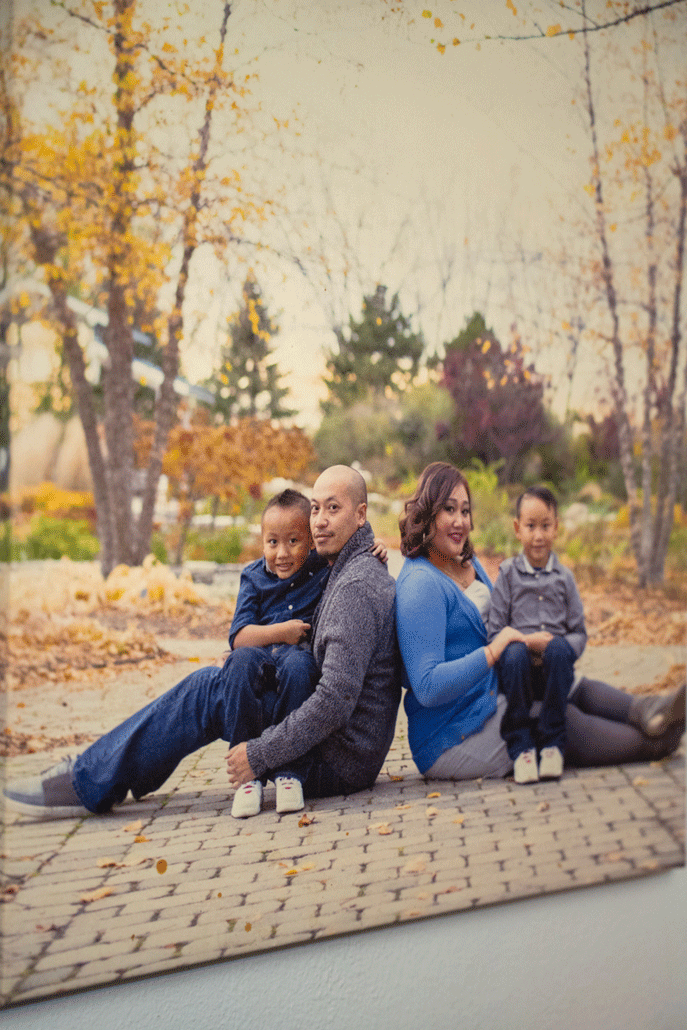
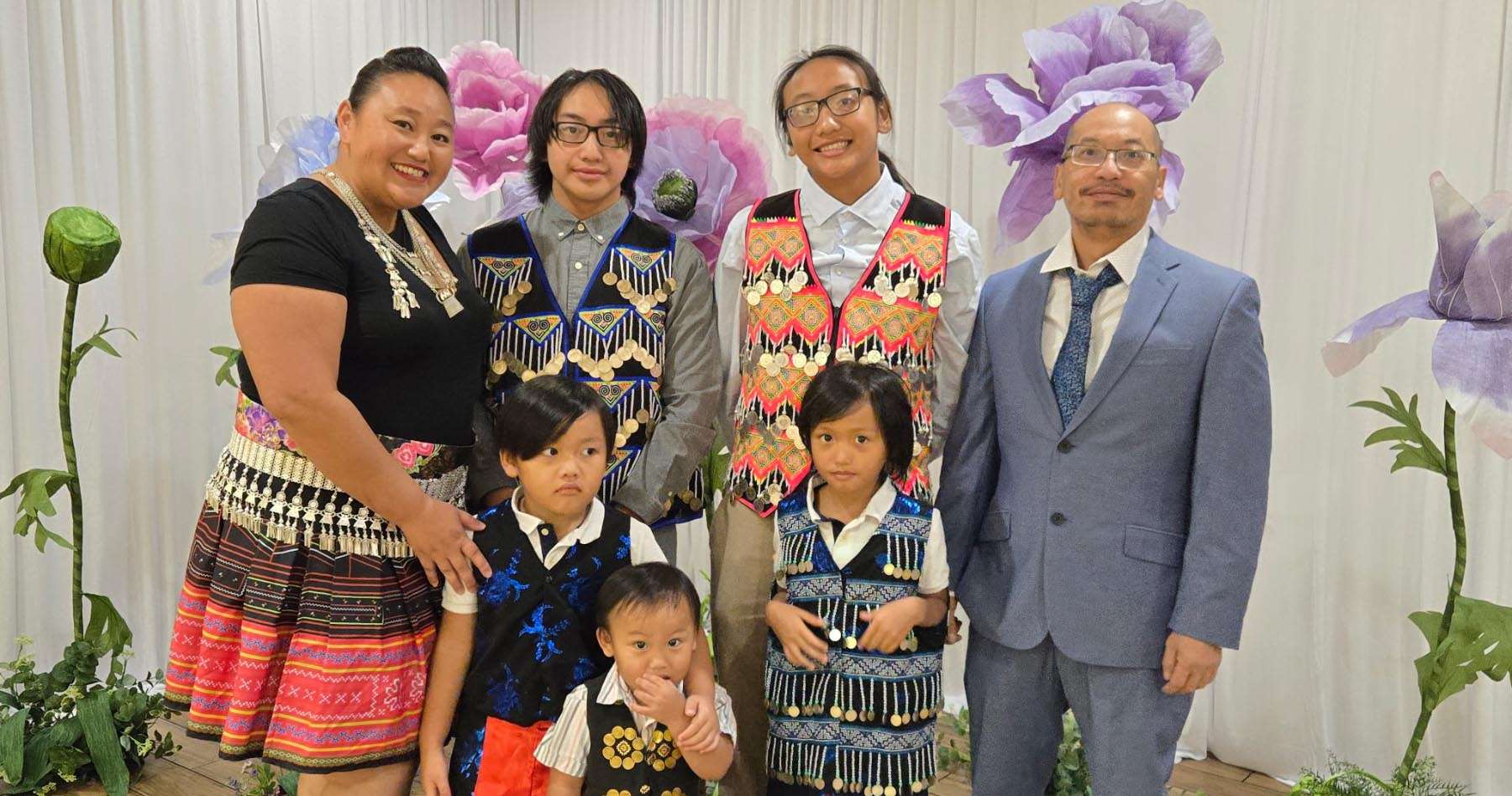
Taken: A family’s story of deportation is an occasional series that will publish throughout the year following the Yang family as they navigate a new normal without husband and father, Zong, who was deported to Laos in May. Linda Yang is now raising their sons alone in South St. Paul, juggling the needs of a recent high school graduate and four other boys ranging in age from 3 to 15.
This story comes to you from the Hmong Times’ partnership with the Sahan Journal, a nonprofit newsroom dedicated to covering Minnesota’s immigrants and communities of color. Sign up for a free newsletter to receive Sahan’s stories in your inbox.
The Past Catches Up
Linda and Zong started looking for attorneys early last year as news began circulating that Hmong residents were being deported. They worried that Zong could be next, and closely followed news about other cases, comparing them to his case.
“It [the detention of Hmong residents] didn’t bother me, but maybe it should’ve, but also maybe it was best that it didn’t get to me, because I would’ve ran or hid,” Zong told Sahan Journal in a video interview from Laos. “I didn’t know anything like this would happen. I wasn’t thinking of this side of the consequences.”
Laos historically refused to accept deportees from the United States but shifted its stance early last year due to political pressure from President Donald Trump’s administration. It’s unclear how many Hmong and Southeast Asian residents have been deported to Laos. However, several Hmong Minnesotans have publicly documented loved ones’ deportations to Laos through Facebook or GoFundMe campaigns.
Linda and Zong held onto hope after seeing a few cases where Hmong detainees were released from federal custody. Michigan Governor Gretchen Whitmer issued a pardon last year for Lue Yang, a father of six whose criminal conviction had been expunged, putting a stop to his deportation. Minnesota resident Thi Dua Vang, a refugee, was detained for two weeks in January before being released on bond. But attorneys told the Yang family there was nothing they could do. The legal costs and severity of Zong’s criminal conviction made it difficult to change his fate.
Zong arrived in the United States with his family at age 3 after they fled Laos as refugees in the wake of the Vietnam War. Many Hmong, including children, had been recruited by the United States to serve as CIA-backed soldiers to fight against communists and to rescue downed American pilots and injured soldiers. As the U.S. military fled after the war, the Pathet Lao and North Vietnamese militaries retaliated against the Hmong community for aiding the Americans, according to the Minnesota Historical Society.
Zong was born in a refugee camp in Thailand, and had never been issued citizenship in Thailand, Laos or the United States. He received a green card when he immigrated to the United States, and said he never applied for citizenship because he assumed that since his green card said, “Permanent Resident,” it secured his lifelong residency in the country.
He was convicted of felony burglary in Wisconsin in 1999 for stealing several semi-automatic handguns from the Gander Mountain store in Appleton, Wisconsin, when he was 21. He was sentenced to 12 years in prison, serving about seven years before he was released at the end of 2006, according to court records. His criminal record also includes a conviction for drug possession in 2019.
The burglary conviction is considered a removal offense by the federal government, and stripped Zong of his green card, and prevented him from ever applying for U.S. citizenship. It also resulted in a final order for deportation against him that required him to regularly check in with ICE at the Whipple building at the discretion of his immigration officer, or until the government could find a country that would accept him as a deportee.
“I should have not done anything like that, taking somebody else’s stuff. It was wrong,” Zong told Sahan Journal. “At that time, my mind was just, I was away from home, but my mind was just not where it was supposed to be.”
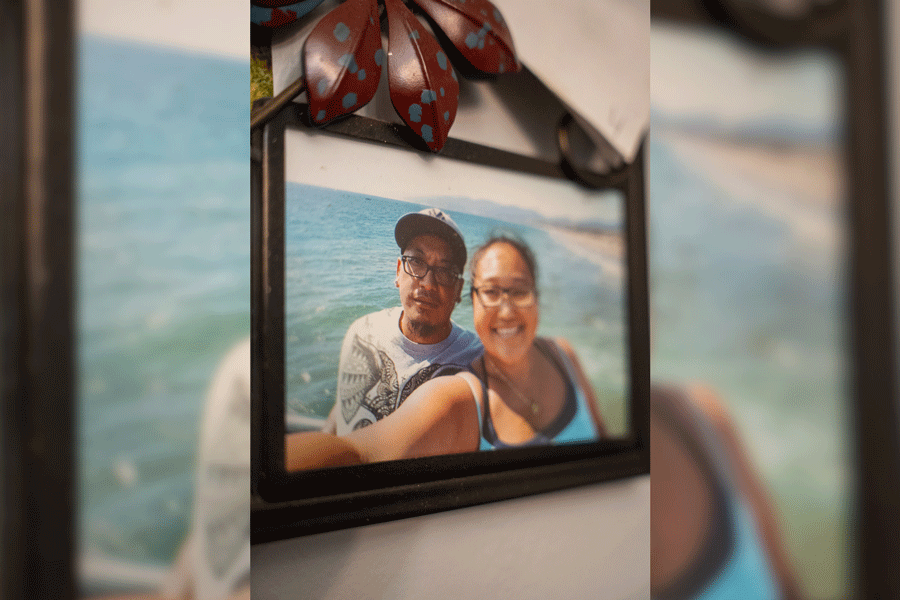
Zong moved to Minnesota for a job and met Linda in 2007 through a mutual friend. She eventually moved to Minnesota from North Carolina, and the two married about a year later. They bought a house where their sons tousled on the living room floor.
Zong never kept his past from Linda. He attended his check-ins at the Whipple building for 20 years. Initially, he checked in every three months, but it varied from every six months to twice a year back to every three months.
Their prior sense of security against Zong’s deportation started falling apart when federal immigration agents started flooding Minnesota last year. In an effort to lighten the mood, they started joking about Zong being deported to Laos, imagining him in different careers and soaking up the warm weather, and Linda visiting on vacation. She pictured growing old with him in Laos after the children had all grown up. They’d retire and buy a house there.
Zong Makes A Plea For His Spirit
Zong arrived at the Whipple building for the last time on February 5, 2026, a chilly Thursday morning. Linda and her brother parked outside the building for about an hour and a half, waiting to pick him up after his check-in.
Federal agents put shackles around Zong’s ankles and brought him into a room with other shackled detainees. He knew he would never return home. He called Linda, who was still waiting outside. She broke down in tears. He was shipped to Camp East Montana in El Paso, Texas, a few hours later.
The U.S. Department of Homeland Security and ICE did not respond to questions about federal agents’ interactions with the Yang family. Zong said there was no time to file any legal challenges in hopes of keeping him in the country or releasing him from custody, or to arrange a visit with an attorney before he was deported.
Zong met about 50 other Hmong, Lao and Vietnamese men while detained in Texas. They were all later transferred to the El Paso Processing Center, where he said they were held for two months.
“It’s just so many thoughts and emotions running through my head,” Zong said of his state of mind while in federal custody. “It was just more of like, ‘This is it.’”
Zong still gets overwhelmed with emotions thinking about the day he was detained and the three months he spent in federal custody. He’s angry that federal agents tried to pick him up a day before his regular ICE check-in, and falsely give his family hope that he would return home after the check-in. But he’s also grateful that he was able to say goodbye. “It was better than just getting snatched up and not spending time with my kids and my wife, you know?” Zong said of his last day with his family.
In many cases, federal agents detained people at work, during traffic stops or while they were fueling their cars at the gas station. Agents detained people at bus stops, and while visiting businesses door-to-door in immigrant-dense neighborhoods, chasing and tackling people in the streets and snow.
Zong, who practices traditional Hmong shamanism, looked out the airplane window on his deportation flight in early May, and pleaded to the heavens to allow his spirit to follow him to Laos, and to let his family know that he did not choose to leave them. “I would never ever be able to step on this American soil again. I would never ever see my kids on American soil, where we built our home,” he recalled thinking at the time.
The Yang Family’s New Chapter
Zong arrived in the Lao capital, Vientiane, on May 9, and was moved into a detention facility for U.S. deportees run by the Lao government. He found a sponsor, who is Hmong and a Lao citizen, to help vouch for him so he could move out into independent housing. Laos requires deportees to find a sponsor, complete multiple rounds of interviews with Lao officials and finish paperwork before leaving the detention facility.
Zong was intimidated buying food at the local market his first few days, because he doesn’t speak the Lao language. But he’s settling in, and making an effort to get to know other deportees. He spends his days going on walks, exploring the city and building up his confidence. He now lives in an apartment about 15 minutes from the National University of Laos in Vientiane. He calls Linda and their sons every day on Facebook or WhatsApp around 7:00 p.m. Minnesota time, or 7:00 a.m. Lao time, and once more before he goes to sleep
Zong and Linda are coping with the turmoil of his deportation by documenting their journey on Facebook to help others going through the same experience, and to help their younger sons understand their father’s story one day. They’ve shared more than 50 posts through written entries, videos and photos chronicling their family’s separation.
Linda, an accountant, has always been the family breadwinner, but Zong’s absence has added financial strain on their family. Zong was working as an overnight freight worker at Home Depot in Inver Grove Heights when he was deported.
She got rid of one of their vehicles to cut costs and finds comfort in the support she’s received from family members. Her nephew and aunt have helped babysit King. Relatives visit more often these days to check on her family. But there’s only so much other family members can do to shore up Zong’s absence.
Linda and Zong’s eldest son, Yaay, graduates from South St. Paul Secondary this year, and plans to attend Winona State University this fall. “It is hard just going through all this without him,” said Yaay, 17. “I was expecting to go through all this with him, and for him to be there during my achievements. But it honestly has pushed me a little in some aspects just to do better and be better.”
Linda and Yaay sat on a sofa in the family’s home in early May as Everest and Titan played with their cousins upstairs. King napped in another room. They cried and laughed as they recalled the last few months and thought about the year ahead without Zong. They didn’t know what the future would bring, but one thing was certain – they wouldn’t let an ocean keep their family apart.