Learning From Laos
By Angela Dickey. board member Legacies of War
Angela is no stranger to the Legacies mission. She was introduced to Legacies by the late U.S. Ambassador to Laos Douglas Hartwick, for whom she worked in Laos 25 years ago. Angela also served as deputy to Ambassador Karen Stewart – current chair of the Legacies board – at U.S. Embassy Vientiane in 2011-2012.
The late journalist Peter Arnett became the news himself in August 1960 after swimming across the Mekong River clenching a news dispatch between his teeth. There had been a coup and simultaneous communications blackout in Laos, so Arnett tried an unconventional method to get the story across the river to Thailand. In those days, the Mekong was known as mighty for a reason. The distance between the Lao and Thai sides was as wide as a soccer field was long, and the current was fast.
These days, you can almost walk across the Mekong from Vientiane to Nong Khai, Thailand, during parts of the dry season. The waters of the “Mother Kong” narrow substantially as they are forced around a new peninsula that developed in reaction to human intervention both far upstream in China and in downtown Vientiane. In mid-January, my spouse and I walked across that peninsula to a new Vientiane “beach” remarkably close to the Thai riverbank.
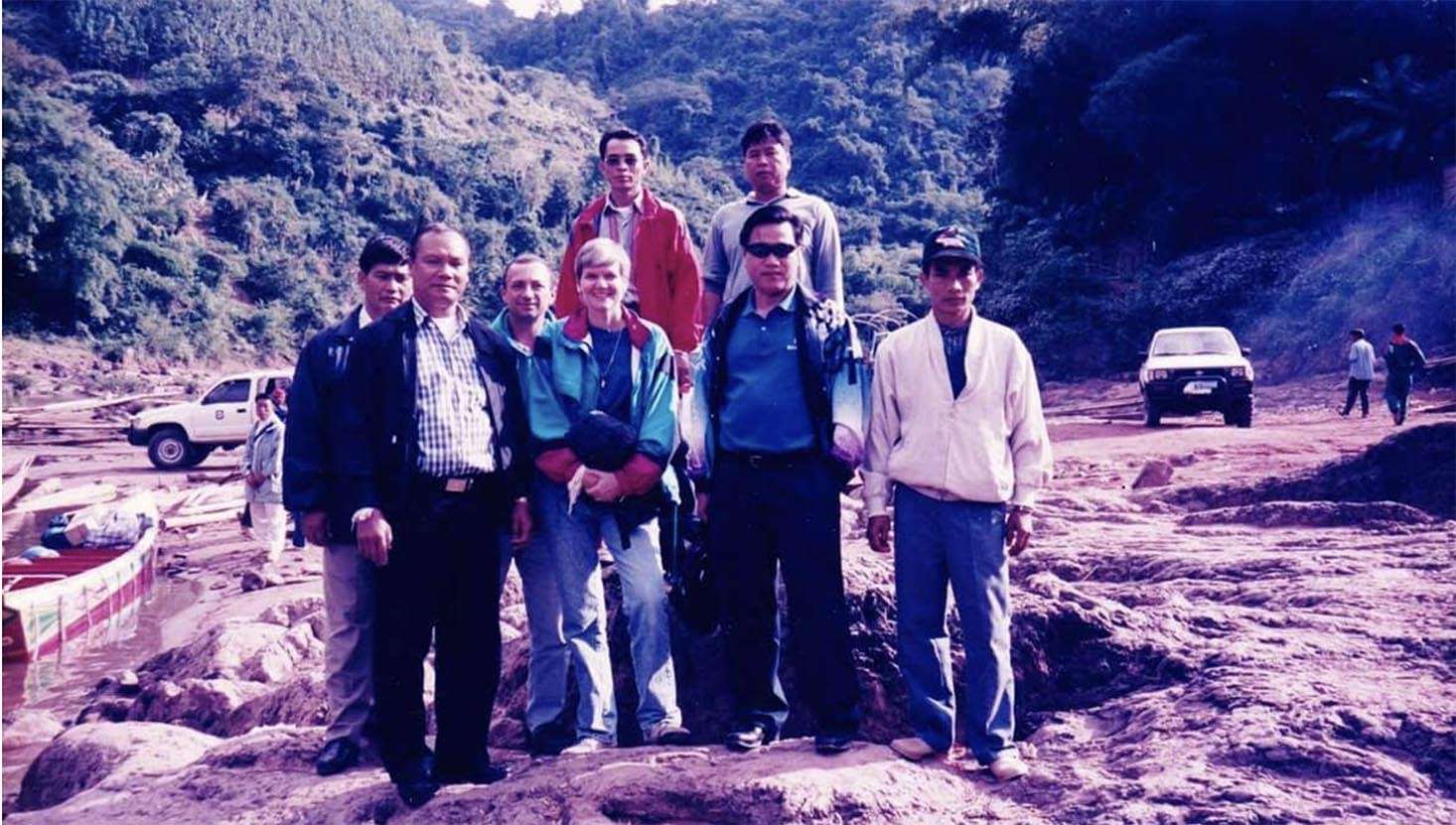
We have been following Laos closely for nearly 30 years, including three years spent living there full-time. As Foreign Service officers we were assigned to the U.S. Embassy in Vientiane from 2000 to 2002, only a quarter century after the end of the Second Indochina War. We came back during 2011 and 2012. So taken were we with Laos and its gentle, resilient people that we kept returning. We also felt “called” to tell the complex story of Lao-American relations to everyone we knew. Over the decades and particularly in the last four years, we have seen enormous changes in a country that – according to most accounts – was able to frustrate or at least baffle foreign influence throughout its history.
The Vientiane we found in 2000 had few paved roads and very few motor vehicles. Cats napped in the streets as four-wheel drive trucks belonging to foreign embassies and non-profits churned up the dust. The embassies and nonprofits were trying to nudge Laos out of 25 years of isolation. Lao history had been abruptly overturned by the retreat from southeast Asia of the United States military in 1973 and the later collapse in 1975 of governments friendly to it in South Vietnam, Cambodia, and Laos.
Having come to power in a true revolution in 1975, the Lao People’s Democratic Republic was deliberately standoffish, although as of the late 1980s it had tentatively followed its neighbor and war ally Vietnam into economic reforms. But in 2000 Laos was still a backwater. At night, from the Thai side, it was hard to see that there was even a town, much less a capital city, in Laos.
It would be another decade before South Korea and other donors funded a bypass road and infrastructure upgrades that had the effect of pushing the Lao bank of the river further out. Today, not only the Korean bypass but the original roads laid out by the French to handle a small riverbank town are bursting. Some streets are being designated one-way, confusing both Lao and foreigners. And the Lao drive their own cars now – luxury models as well as electric vehicles from China. A longtime American resident of Vientiane told us there are 26 Rolls Royce motor cars in Vientiane.
Whereas 25 years ago I naively believed that Thailand was the biggest “influencer” in Laos, mainly through media and the similarities between the Thai and Lao languages, I now see that China was looming in the background the whole time. The PRC’s first conspicuous “gift” to Laos was a lavish “cultural hall” that remains one of the largest event venues. But then the impacts of loans for infrastructure and the building of dams on the Mekong kicked in. It now seems that the Lao who ducked and weaved to survive French, Thai, American and Vietnamese influence can’t just say “no” to China.
The think tank Stimson Center in Washington, DC, has for some years now been tracking how mainly Chinese-built mega dams on the upper Mekong are changing the flood pulse and the agricultural yields and ecosystem further downstream. Stimson also now is running a separate infrastructure tracker that features interactive maps and other resources depicting the road and energy networks pulling together all parts of the Mekong region. A great deal of it has been financed and/or built by China as part of its “Belt and Road” vision.
It’s now possible to drive from Yunnan Province to Luang Prabang and Vientiane, which explains why Chinese tourist buses are ubiquitous along with Chinese malls and Chinese restaurants. The Chinese are completing a new expansion of Luang Prabang’s International Airport that will facilitate non-stop service between that World Heritage City and major Chinese cities.
Meanwhile, there is now a very nice fast train linking the Chinese border and Vientiane via Luang Prabang. A Chinese American friend likened the Chinese fondness for vacationing in Laos to Americans’ love for heading to Mexico in the winters.
We took the train in 2023, making the Vientiane – Luang Prabang leg in two hours. Just 15 years ago, U.S. Embassy four-wheel-drive vehicles slogged for two days over bad mountainous roads to make the trip.
One wonders how anyone can afford a vehicle given the exchange rate. It is a cheap time for foreigners to visit, but how ordinary Lao can afford life is another matter. Since COVID we’ve seen small shops and homeowners put up “for sale” signs. Land is being picked up by bigger investors from China, Korea, and elsewhere. There is a new Hyatt Regency hotel in the tourist district. We heard stories that more youth are leaving to find work in Thailand and elsewhere. Sadly, the rate of children of all ages attending school reportedly has gone down. Several old-timers told us that the country is slowly losing its future generations to other destinations.
We are still haunted by the prescient question that a late Lao friend asked rhetorically in late 2012 at the conclusion of our second posting: “Are we to become like Tibet?”
Images courtesy Legacies of War.