From the Shadows to Recognition: Minnesota Moves to Honor Hmong Secret War Veterans
By Kim Yang
For decades, their story lived in the margins of history—spoken quietly within families, remembered in community gatherings, and carried in the hearts of those who fought a war few Americans ever fully understood. Now, in 2026, that story is moving into the light as Minnesota lawmakers take significant steps toward recognizing Hmong and Lao veterans of the Secret War in Laos.
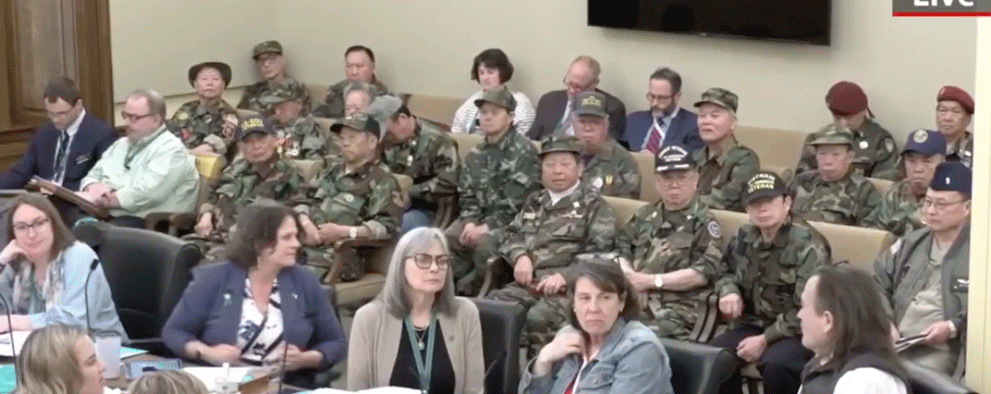
In late April, the Minnesota Senate approved legislation that would grant partial veteran status to members of the Special Guerrilla Units (SGU), a CIA-backed force that played a critical role during the Vietnam War era. The bill represents more than policy—it is a long-awaited acknowledgment of sacrifice, service, and a complicated chapter of American history.
The SGU fighters were recruited largely from Hmong communities in Laos during the 1960s and early 1970s. Working alongside the CIA, they carried out covert operations aimed at disrupting communist supply lines, gathering intelligence, and supporting U.S. military efforts in Southeast Asia. Their mission was dangerous, relentless, and largely invisible to the outside world.
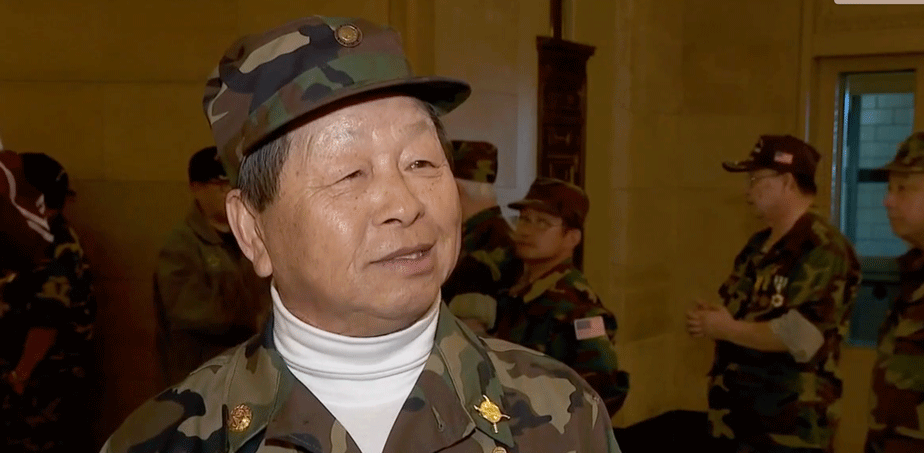
Major Gia Tou Lee, a former SGU member, described the reality of their service with stark clarity: “…us for airstrikes to bomb the communists, place to place, help them [the CIA] make sure they had enough equipment for fighting. We did everything according to what they wanted us to do, but we come here and get nothing.”
That sense of having given everything—and received little in return—has shaped the lived experience of many SGU veterans who eventually resettled in the United States, particularly in Minnesota, home to one of the largest Hmong populations in the country. Today, approximately 1,000 SGU veterans are still alive in the state, carrying with them the memories of a war that was never officially theirs.
The legislation currently advancing through the Minnesota Legislature seeks to change that narrative. Known as House File 3919, the bill outlines a framework for providing partial veteran benefits to these individuals. Among the proposed benefits are burial privileges at state veterans’ cemeteries, preferences in state employment hiring and promotions, and the potential for a special designation on drivers’ licenses recognizing their service.
While these benefits fall short of full federal veteran status, they represent a meaningful step forward—both symbolically and practically. For many SGU veterans and their families, burial honors alone carry deep cultural and emotional significance, affirming a lifetime of sacrifice that has too often gone unrecognized.
The momentum behind this legislation has been building for years. In February 2026, a recommendation report addressing the status of SGU veterans was submitted, adding weight to decades of advocacy efforts. Community leaders, veterans’ groups, and policymakers have worked together to bring visibility to the issue, pushing for acknowledgment at both the state and federal levels.
Minnesota has already made history in this regard. In 2025, it became the first state to formally recognize SGU members as veterans. The current legislation builds on that foundation, moving beyond recognition toward tangible benefits that reflect the realities of their service.
The Senate’s approval on April 22, 2026, marked a significant milestone, but the process is not yet complete. The bill must still pass the Minnesota House before it can be signed into law by the governor. Early indications suggest strong support, with lawmakers expected to secure the necessary votes before the end of May.
Behind the legislative language lies a deeper story—one of resilience, displacement, and enduring loyalty. After the fall of Laos to communist forces in 1975, many SGU veterans and their families faced persecution, forcing them to flee their homeland. Thousands eventually found refuge in the United States, rebuilding their lives while carrying the legacy of their service.
For younger generations of Hmong Americans, this moment represents both recognition and education. It is an opportunity to learn about a hidden history that shaped their families and communities, and to see that history acknowledged in a public and lasting way.
The proposed benefits also address a broader issue: the gap between federal and state recognition. While SGU veterans have long sought full acknowledgment from the U.S. government, progress at the federal level has been limited. State-level initiatives like Minnesota’s offer a path forward, providing immediate support while continuing to advocate for broader recognition.
At its core, the legislation is about more than benefits—it is about dignity. It affirms that the sacrifices made in the jungles of Laos, often under extreme conditions and with limited resources, were not forgotten. It recognizes that these men fought not only for their homeland but also in support of American objectives, forging a bond that deserves acknowledgment.
The story of the SGU is one of courage in the shadows, of alliances forged in secrecy, and of a long journey toward recognition. As Minnesota moves closer to passing this legislation, it sends a powerful message: that even the most overlooked chapters of history can find their place in the public record.
For Major Gia Tou Lee and the many others who served, that recognition comes after decades of waiting. It is not a complete resolution, but it is a meaningful step—one that honors the past while shaping a more inclusive understanding of what it means to serve.
As the final votes approach, the outcome seems increasingly certain. And with it comes a moment of long-overdue acknowledgment for a group of veterans whose contributions helped shape history, even if that history remained hidden for far too long.