The Echo Of Our Ancestors: Fifty Years Of Hmong American Hope
By Cha Vang, Son Of General Vang Pao
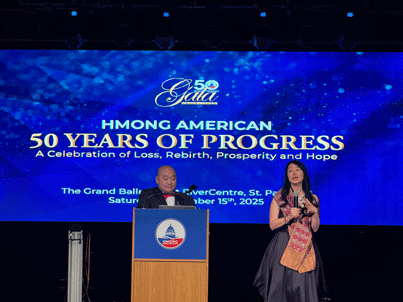
On November 15, 2025, I walked into the Grand Ballroom at the Saint Paul RiverCentre and felt a weight I have carried my entire life settle onto my shoulders – yet for the first time, it was a weight shared by more than 1,200 Hmong brothers and sisters gathered in one place. The sold-out HC100 gala, “Hmong American: 50 Years of Progress – A Celebration of Loss, Rebirth, Prosperity, and Hope,” was more than an event. It was a homecoming, a remembrance, and a collective declaration that our story – our people – have not only survived history but made history.
As the son of General Vang Pao, I have attended countless community gatherings over the decades. But on this night, something was different. This celebration carried the emotional power of five decades of struggle and triumph. It honored a people who came to America with nothing and turned that nothing into universities, businesses, political leadership, military service, artistic achievement, and thriving families. This was the kind of night my father dreamed of, prayed for, and worked toward his entire life.
A Gathering That Felt Like Destiny
The Hmong Committee of 100 (HC100) brought together a remarkable cross-section of our community – scholars, elected officials, veterans, entrepreneurs, artists, educators, elders, youth, and multigenerational families. The ballroom felt alive with color, pride, and purpose. People embraced old friends and made new introductions, sharing stories of the journey from refugee camps to American cities.
Looking across that vast ballroom, filled with 1,200 attendees, I couldn’t help but think of where our people began – displaced in the mountains of Laos, hunted for choosing freedom, scattered across refugee camps with no guarantees, and later resettled in unfamiliar American towns. Yet here we stood, many of us prosperous, educated, engaged, and grateful. Let us not forget – it is our duty to encourage and lift up the members of our community who dearly need our support: the men, women, and children who were not in the room but are still very much our Hmong brothers and sisters.
HC100’s vision for the evening was clear: to honor the last 50 years while igniting inspiration for the next 50. And they delivered.
Honoring History And Those Who Carried It
Throughout the night, I listened to speakers whose voices carried wisdom, leadership, and conviction. Dr. Chia Youyee Vang opened with a moving reflection on the historical forces that shaped the Hmong narrative – war, survival, migration, and reinvention. She reminded us that our community’s progress is not an accident; it is the result of sacrifice and determination from both past and present generations.
Senator Foung Hawj spoke with the steady authenticity that has defined his public service. He highlighted not only how far we have come but how far we still must go to ensure Hmong Americans have equal access to political, educational, and economic opportunity. His message was clear: our community has the talent; we must now strengthen the pipelines that support it.
Judge Adam Yang and Dr. Pakou Yang emphasized the intellectual and professional contributions of Hmong Americans across industries – from education to law, from healthcare to public service. Their presence on stage symbolized a hope my father often carried: that Hmong children would one day not have to apologize for who they are, but instead lead proudly because of who they are.
Dr. Umeng David Thao, Natalie Kia Yang, Col. Yee Hang (Ret.), and J. Kou Vang added depth, humor, and heartfelt honesty throughout the program. Each speaker represented a branch of the Hmong American journey – academic leadership, military service, business innovation, and civic engagement. Together, they painted a portrait of a people no longer defined by tragedy, but by achievement.
A Tribute To The Builders And The Brave
One of the most emotional moments of the night came when HC100 recognized community pioneers – those who guided Hmong families through resettlement, fought for civil rights protections, founded cultural institutions, and preserved traditions when it would have been easier to abandon them.
Watching elders stand to accept applause, I felt a tug in my chest. They are the bridge between worlds, between past and present, between war and peace. Many of them knew my father personally. Many fought alongside him or followed him through the darkest years. They built the foundation that my generation and our children now stand upon.
The gala also honored emerging leaders – young Hmong Americans breaking barriers in medicine, technology, business, the arts, and government. Their achievements are not just personal wins; they are communal symbols of how far we have come.
A Premiere That Made The Room Fall Silent
A documentary segment premiered during the event, offering a sweeping cinematic view of five decades of Hmong American life. The room fell completely silent, but for stifled tears, as archival footage of the Secret War played across the screens. Images of soldiers in the mountains of Laos, exhausted mothers carrying infants, families boarding planes to America – it stirred memories that many in the room lived through.
As the son of a man who dedicated every breath to protecting our people, I felt a profound sense of responsibility watching those images. My father wanted our history to be remembered not with bitterness, but with honor. He wanted our children to understand the cost of freedom. And he wanted America to know that the Hmong people have always been loyal, courageous, and resilient. That documentary segment captured this truth beautifully.
A Celebration Of Culture And Identity
The evening featured cultural performances that filled the ballroom with the sounds of traditional instruments, the colors of embroidered regalia, and the energy of youth performers who danced with confidence and pride. These performances reminded us that no matter how far we advance in American society – earning degrees, starting companies, entering public office – our cultural heartbeat is what sustains us.
To see young children performing dances that were nearly lost during war and displacement was a breathtaking testament to cultural survival.
Acknowledging Those Who Made the Night Possible
Many thanks to the volunteers who worked tirelessly to create such a beautiful and meaningful experience. Their dedication ensured that every moment – from the program to the performance – reflected the heart and dignity of our community.
I also want to extend special gratitude to the Frederick Douglass Project (fdproject.org) for inviting me, my friends, and my family as their guests. Our tables were a vibrant reflection of America itself – made up of people of different races, backgrounds, and political beliefs. Yet what united us was far greater than anything that could divide us: a shared love, respect, and deep appreciation for the sacrifices and contributions of the Hmong people in the United States.
What This Night Meant To Me
As I walked from table to table greeting elders, families, and community leaders, many asked the same question: “What would your father say if he saw this?” I believe he would smile. He would thank the leaders who carried on the work after him. He would praise the youth for pursuing education. However, my father would remind us: let us stay united, advocate for each other, and honor our ancestors. And he would stress that the next 50 years depend on what we choose to build – together.
For me personally, the night was both emotional and healing. I felt pride not only as a son, but as a member of a people who transformed unimaginable hardship into prosperity and hope. Our story is one of the greatest American success stories, yet too few know it. Nights like this help change that.
Looking Ahead: The Next 50 Years
HC100’s 50-year celebration was not just a reflection – it was a launchpad.
The organization emphasized future goals:
• strengthening civic engagement
• supporting youth leadership
• preserving cultural identity
• advancing economic development
• and ensuring the next generation inherits a strong, unified community
If the energy in that ballroom is any indication, the next 50 years of Hmong American progress will be even more remarkable than the last.
The Echo Of Our Ancestors Lives On
As the evening came to a close and guests embraced, posed for photos, and lingered long after the program ended, one truth was clear: this night was historic. It was a reminder that the Hmong story did not end in the mountains of Laos or in refugee camps. It is still being written – boldly, proudly, and together.
And I am honored to witness it, to celebrate it, and to help carry it forward.